


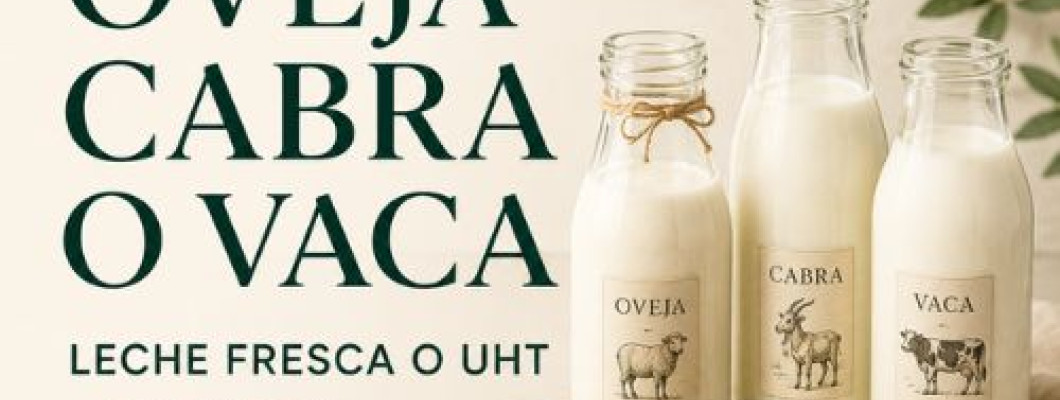
For decades, "milk" meant cow's milk. In the chiller at our stores there are now three different animals, and the question we get asked most in front of that shelf is always the same: which one do I take?
There isn't a single answer, but there are clear criteria. And there's one difference almost nobody considers that matters more than the species: whether the milk is fresh, or whether it has been through a UHT process.
The short version
- Sheep: the most nutritious and the creamiest. Almost double the protein and calcium of cow's milk. Also the most calorific.
- Goat: the one that agrees with most people, thanks to its fat and protein structure. It is not an option if you have a cow's milk protein allergy.
- Cow: the most neutral and versatile. The real difference isn't the animal — it's fresh versus UHT.
- None of the three works if you are lactose intolerant: all three contain it.
- Fresh milk lasts days and tastes of something. UHT lasts months and tastes of UHT.
What each one gives you
Approximate values per 100 ml. They vary with the farm, the animal's diet and the season, so treat them as orders of magnitude, not as a label.
| Per 100 ml | Whole cow | Goat | Sheep |
|---|---|---|---|
| Energy | ~64 kcal | ~69 kcal | ~105 kcal |
| Protein | 3.2 g | 3.4 g | 5.4 g |
| Fat | 3.6 g | 4.1 g | 6.5 g |
| Calcium | 120 mg | 134 mg | 190 mg |
| Lactose | 4.7 g | 4.4 g | 5.1 g |
The quick read: sheep's milk is a denser food — less volume delivers more. Goat's milk looks a lot like cow's on paper, and its difference lies elsewhere. Cow's milk is the lightest of the three.
Sheep's milk: the most nutritious and the creamiest
It's the one that surprises people most on first taste. It has body, a faint sweetness and leaves a cream-like feel without being cream. In coffee it goes much further: a smaller pour already changes the texture.
Its strength is nutritional density. Almost twice the protein and 60% more calcium than cow's milk. That makes it interesting when you want to deliver more in less volume: in childhood, in older age, or simply if you don't eat much at breakfast. The trade-off is that it's also the fattiest and most calorific, so if you're trying to lighten things up, it isn't your milk.
The kitchen is where it shines: it sets better, gives thicker yoghurts and kefirs with no thickeners, and in baking it brings a richness you don't have to correct with cream.
Where ours comes from: Mas Casas Cruïlles
It's a family farm in Cruïlles, in the Baix Empordà. Salvi and Anna run it — third-generation shepherds in the same house.
What sold us wasn't the brochure: it was how they manage the flock. They work with rotational grazing and holistic herd management, and the sheep go out to pasture every day. They put it bluntly on their own website: they could extract more milk doing it differently, but they prioritise the animals' welfare. Coming from a farmer, that sentence is worth more than any label.
They control the whole process, from genetics to feed, and they process on the farm itself. That's where the whole range comes from:
- Fresh pasteurised sheep's milk 1 L — the base product.
- Natural sheep yoghurt 210 g and the apple jam version.
- Sheep kefir 180 g — fermented, spoonable.
- Fresh sheep cheese 160 g and spreadable cheese with herbs 180 g.
Goat's milk: the one that agrees with most people
Here we need to separate what's true from what simply gets repeated.
What is true: goat's milk has smaller fat globules and a different casein profile — considerably less alpha-s1-casein than cow's milk. That makes it form a softer curd in the stomach, and many people digest it more comfortably. It isn't placebo: it's structure.
What is not true: that it works for cow's milk protein allergy. Cross-reactivity between the two is very high, so with a diagnosed allergy goat's milk is not an alternative. Nor does it work for lactose intolerance: it carries practically the same amount as cow's milk.
In flavour it's more pronounced than cow's and lighter than sheep's. It works very well in coffee, in porridge and in sauces, and it makes yoghurts with real character.
Where ours comes from: Mas Claperol
They're in Sant Feliu de Pallerols, in the Garrotxa. Emili Domènech arrived at Mas Claperol in 1982 and started with 60 goats.
The detail we most like telling is from 1995: they were among the first cheese producers in Catalonia to carry organic certification, back when organic didn't sell and made the papers as a curiosity. That's more than thirty years ago, and they're still a small family operation — their cows all have names.
Their range, all organic certified:
- Fresh goat's milk 1 L and fresh cow's milk 1 L.
- Natural goat kefir 450 g.
- Yoghurts: goat 450 g, goat in 2×128 g packs, sheep 450 g and cow 2×128 g.
- Cheeses: Roca Negra goat 300 g, Cairat soft goat cheese 400 g and the Pyrenean blue raw cow's milk 150 g.
Cow's milk: the usual one, if it's a good one
Cow's milk needs no defending: it's the most neutral, the most versatile and the cheapest of the three. If you use it for everything — coffee, cereal, béchamel, baking — it's still the most practical option.
What does change a lot is quality. Fresh milk from a small farm and UHT milk from a supermarket are two different products, even if the label says the same thing. Which brings us to the question that actually matters.
Fresh or UHT: the difference you notice most
Choosing well between sheep, goat and cow changes something. Choosing between fresh and UHT changes everything.
- Pasteurised (fresh): heated to around 72-75 °C for a few seconds. It removes pathogenic microorganisms and leaves the flavour and structure of the milk practically intact. Always refrigerated, and it lasts a few days.
- UHT: heated to around 135-150 °C. It keeps for months outside the fridge, and that's its entire merit. The heat modifies the whey proteins and creates that "cooked" taste we associate with supermarket milk.
Nutritionally the gap is smaller than people think: calcium and protein hold up well either way. Where it really shows is in flavour, texture and how it behaves when you cook with it. If you've never tried fresh milk from a small farm, that's the experiment we'd recommend before any other.
The trade-off is honest: it lasts only days, it has to stay refrigerated and it costs more. If you buy milk once a month, fresh isn't for you.
Which one to choose, and for what
- For coffee: sheep for creaminess without cream; goat if you like more character; cow if you want it to stay out of the way.
- For sensitive digestion: goat, for its fat and casein structure. As long as there's no diagnosed allergy.
- To deliver more in less: sheep, no argument.
- For homemade yoghurt or kefir: sheep, because it sets thicker without adding anything.
- For everyday cooking: fresh cow's milk. Neutral and good value.
- For children: any of the three from one year old, but ask your paediatrician before changing the basis of their diet.
Frequently asked questions
Does goat's milk work if I'm allergic to cow's milk?
No. Cross-reactivity between cow and goat proteins is very high, so with a diagnosed cow's milk protein allergy, goat's milk is not a safe alternative. Always check with your allergist.
What if I'm lactose intolerant?
None of the three will do: goat's milk has 4.4 g of lactose per 100 ml and sheep's 5.1 g, against 4.7 g for cow's. The difference is irrelevant. You need lactose-free milk or plant drinks.
How long does fresh milk last once opened?
Three to four days in the fridge, always below 4 °C and at the back, not in the door. Unopened, respect the date on the carton: it's short by definition.
Why is sheep's milk more expensive?
Because a sheep gives far less milk than a cow, and because these farms are small and process on site. Price per litre is a poor comparison: sheep's milk goes further per glass.
Do I need to boil fresh milk?
No. It's pasteurised, meaning it has already had a heat treatment that removes pathogens. Boiling it only ruins the flavour. Raw milk is a different matter — these are not raw.
Is it normal for cream to rise to the top?
Yes, and it's a good sign: it means the milk isn't homogenised. Shake the carton before pouring.
Try them
Our recommendation, if you never have: buy a litre of each and taste them on the same day, on their own, without coffee. The difference between the three lands in three sips far better than in three paragraphs.
You'll find the full fresh milk, yoghurt and cheese sections in the online shop, and in any of our stores we'll let you taste before you decide.
This content is informational and does not replace advice from a healthcare professional. If you have a diagnosed allergy or intolerance, or you are changing a child's diet, check with your doctor, paediatrician or dietitian first.