


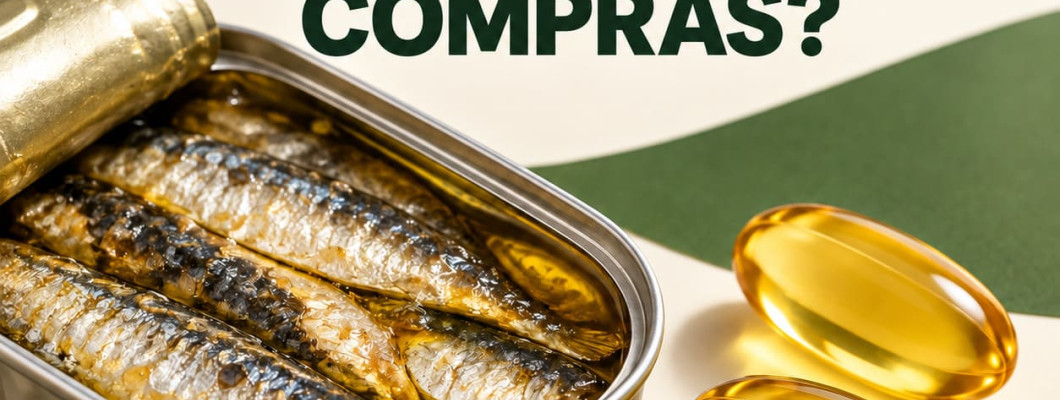
Pick up a bottle of omega 3 and read the front: "1,000 mg". Turn it around and find the small print: "EPA 180 mg, DHA 120 mg". Both numbers are true, but only one of them matters, and it isn't the one on the lid. That gap explains why two bottles that look identical can cost the same and give you three times less.
Here is what to check so you don't pay for filler: what EPA and DHA actually are, how much EU law says you need, why the omega 3 in flax and chia does not replace the omega 3 in fish — even though we sell flax and chia — and when the tin of sardines beats the capsule.
In short
- The number that counts is not milligrams of oil, it is milligrams of EPA + DHA. A 1,000 mg softgel of unconcentrated fish oil usually delivers around 300 mg.
- 250 mg a day of EPA and DHA is the adequate intake EFSA sets for adults, and the exact amount behind the EU authorised health claim for the heart.
- DHA has a claim of its own, also at 250 mg a day, for brain and vision.
- For triglycerides and blood pressure the authorised doses are far higher: 2 g and 3 g a day of EPA and DHA.
- Flax, chia, hemp and walnuts give you ALA, not EPA or DHA. Conversion runs below 15 %. We say so even though we sell all four.
- Two servings of oily fish a week cover those 250 mg comfortably. For most people the bottle is unnecessary.
- Safety ceiling: EFSA found no concerns up to 5 g a day of supplemental EPA+DHA (2012), and in 2026 set the safe level for supplemental DHA at 1 g a day.
What omega 3 is, and why the seed version isn't the same
Three different fatty acids share the name "omega 3", and the body does not treat them alike. ALA is the plant one: flax, chia, hemp, walnuts. EPA and DHA are the marine ones: oily fish, krill and microalgae. Every piece of evidence on heart, brain and vision is built on EPA and DHA. EFSA separates them even in its reference values for adults: 0.5 % of energy as ALA, 4 % as linoleic acid (the omega 6) and 250 mg a day of EPA + DHA.
Here is the first myth worth dismantling, and it costs us money: two tablespoons of loose golden flaxseed are not the equivalent of a sardine. The body can elongate ALA into EPA and DHA, but the NIH Office of Dietary Supplements puts that conversion at under 15 %, and Burdge and Calder (Reproduction Nutrition Development, 2005) conclude that conversion to EPA is limited in men and the fraction reaching DHA is "very low", somewhat higher in women. Flax, chia, hemp and walnuts are excellent foods for other reasons, but they are not your DHA source. They are all in seeds and dried fruit and nuts.
Five things to check on the label before you buy
1. Look for milligrams of EPA and DHA, not milligrams of oil
This is the most expensive mistake and the easiest to avoid. "Fish oil 1,000 mg" describes the capsule, not the active compound: unconcentrated oil carries around 30 % EPA and DHA — the classic 18/12 ratio — so that softgel leaves you near 300 mg. A concentrate can carry double or triple in the same volume. Multiply the mg of EPA + DHA by the number of softgels in the daily dose and compare that figure. Fatty acids holds both kinds, from a triglyceride-form concentrate to a standard 450/300.
2. Decide whether you want EPA, DHA or both
EU law separates them precisely. For the heart the claim is joint: "EPA and DHA contribute to the normal function of the heart", at 250 mg a day of EPA and DHA. For brain and vision only DHA carries the claim — "DHA contributes to maintenance of normal brain function" and "to the maintenance of normal vision" — also at 250 mg a day. If that is what you are after, a product with high DHA makes sense; if your interest is cardiovascular, look at the circulatory system range.
3. Freshness matters more than you would think
Omega 3 oxidises: that is its chemistry. Albert and colleagues analysed 32 fish oil supplements in Scientific Reports (2015): only 3 of 32 contained the EPA and DHA on the label, 69 % held less than two thirds of the stated amount, 83 % exceeded the recommended peroxide limit and half went over the TOTOX index. Only 8 % met every international recommendation. And expiry date, price and country of origin all turned out to be poor predictors of quality.
In practice: opaque or dark glass packaging, formats you finish in weeks, and suspicion of anything that smells strongly of rancid fish. Liquid formats go in the fridge once opened; gummies solve the problem for anyone who can't swallow softgels.
4. Check which animal — or which alga — it comes from
Oil from small oily fish (anchovy, sardine, mackerel) is the standard across the literature. Krill carries the same fatty acids bound to phospholipids, at lower doses per capsule. Cod liver oil adds vitamins A and D: an advantage, and also a reason not to double the dose or blindly combine it with a multivitamin from vitamins and minerals.
5. If you are vegan, algae is the only real route
There is no plant shortcut: DHA from microalgae is the same DHA as in fish, because in the sea the alga makes it and the fish merely accumulates it. It is the only way to get EPA and DHA without fish, and it carries no heavy metal problem. You'll find it as vegan capsules and as liquid algae oil.
How much omega 3 is in what
Figures from the NIH Office of Dietary Supplements fact sheet. Watch the third column: fish gives you EPA and DHA; seeds and nuts give you ALA, which is a different thing.
| Food or product | Serving | What it provides | Amount |
|---|---|---|---|
| Atlantic salmon, cooked | 85 g | EPA + DHA | 1.83 g |
| Canned sardines | 85 g | EPA + DHA | 1.19 g |
| Atlantic mackerel | 85 g | EPA + DHA | 1.02 g |
| Chia seeds | 28 g | ALA (no EPA or DHA) | 5.06 g |
| Walnuts | 28 g | ALA (no EPA or DHA) | 2.57 g |
| Flaxseed | 1 tbsp | ALA (no EPA or DHA) | 2.35 g |
| Unconcentrated fish oil softgel | 1,000 mg | EPA + DHA | ≈ 0.3 g |
Put another way: one tin of sardines leaves three or four unconcentrated softgels behind, and throws in protein, calcium and vitamin D. Sardine, mackerel, frigate mackerel and anchovy are all in canned fish.
Which dose for which goal
What can legally be claimed in Europe, and at what amount. The wording is taken verbatim from Regulation (EU) 432/2012.
| Goal | EU authorised claim | Daily dose | How to get there |
|---|---|---|---|
| Heart | "EPA and DHA contribute to the normal function of the heart" | 250 mg EPA + DHA | 2 servings of oily fish a week |
| Brain and vision | "DHA contributes to maintenance of normal brain function" / "to the maintenance of normal vision" | 250 mg DHA | High-DHA product, or algae |
| Triglycerides | "DHA and EPA contribute to the maintenance of normal blood triglyceride levels" | 2 g EPA + DHA | Concentrate, under professional guidance |
| Blood pressure | "DHA and EPA contribute to the maintenance of normal blood pressure" | 3 g EPA + DHA | High dose; discuss with your doctor |
| Cholesterol (plant route) | "ALA contributes to the maintenance of normal blood cholesterol levels" | 2 g ALA | 1 tbsp of ground flaxseed |
Two warnings go with that table. The triglyceride and blood pressure claims may not be used on food intended for children, and those doses belong under professional supervision. And the NIH notes that between 2 and 15 g a day of EPA and/or DHA may lengthen bleeding time: if you take anticoagulants or antiplatelet drugs, this is a conversation to have first.
The shopping list
Omega 3 supplements: Premium Omega 3 TG · Omega 3 450/300 · DHA 1000 mg · krill oil · cod liver oil · Omega 3 Arktis liquid · gummies.
Vegan version: algae capsules and liquid algae oil and vegan EPA liquid, with the rest of the range in fatty acids.
The part you eat, which is where most of the return is: sardines in EVOO, mackerel, frigate mackerel, Cantabrian anchovies, canned salmon and the rest of canned fish.
For ALA, loose: golden flaxseed, chia and hemp, with the full range in seeds and nuts.
What completes the plate: oils and vinegars, legumes, eggs, spices, vegetables and the rest of the pantry, plus chilled, frozen and drinks. If you'd rather not decide, there are the organic baskets and the offers.
Where to buy omega 3 in Barcelona and Sant Cugat
Omega 3 is the supplement where holding the bottle helps most: at the counter you do the only calculation that matters — milligrams of EPA plus DHA per daily dose — in thirty seconds, and compare it with the one next to it. On a screen that is three tabs and a nutrition table stored as an image. And there is one thing a marketplace will never do: tell you not to buy the bottle. If you eat oily fish twice a week, you already reach 250 mg and that money is better spent on the tin.
We have three shops:
- Provença 242, 08008 Barcelona — Eixample, between Balmes and Enric Granados.
- Còrsega 78, 08029 Barcelona — Eixample, near Sants station.
- Antoni Bell 2, 08174 Sant Cugat del Vallès — Volpelleres, next to the station.
If you'd rather ask first, the phone is 683 118 961 and the email is linverd@linverd.com.
Do you actually need an omega 3 supplement?
For most healthy people, no. The Cochrane review by Abdelhamid and colleagues (2020) pooled 86 trials and 162,796 participants: increasing long-chain omega 3 has little or no effect on all-cause mortality or on cardiovascular events. It does slightly reduce coronary heart disease risk — between 167 and 334 people would need to increase their intake to prevent one event — and lowers triglycerides by around 15 %. With ALA the pattern is similar.
That doesn't make omega 3 snake oil. It puts it where it belongs: a nutrient worth not running low on, with a modest effect when added on top of a diet that already contains it. And in Spain we eat less of it every year: according to the Ministry of Agriculture, Fisheries and Food report La pesca mes a mes, household consumption stood at 17.51 kg per person per year in November 2025, 1.8 % down on the previous year. That gap is filled faster with the tin than with the capsule.
Second myth, and this one also costs us a sale: "omega 3-6-9" formulas are not more complete, they are more diluted. We already get plenty of omega 6 in any Western diet — the adequate intake for linoleic acid is 4 % of energy and is reached without effort — and omega 9 isn't even essential: the body makes it and it's in the olive oil you already use. Every milligram taken up by 6 and 9 is a milligram not taken up by EPA and DHA. We stock those formulas and the advice stands: buy omega 3, not the whole alphabet.
One local note: Spain's food safety agency AESAN recommends avoiding swordfish, shark, bluefin tuna and pike during pregnancy, breastfeeding and under the age of 3, and limiting them to 50 g a week or 100 g every two weeks between ages 3 and 12, because of mercury. It does not apply to small oily fish — sardine, mackerel, anchovy — which is exactly the group richest in EPA and DHA and lowest in accumulated mercury.
Frequently asked questions
How much omega 3 should you take per day?
EFSA sets an adequate intake of 250 mg a day of EPA and DHA for adults, and that is the amount behind the EU authorised claim on normal heart function. For triglycerides and blood pressure the claims require 2 g and 3 g a day, which are doses for medical supervision.
What is the difference between EPA and DHA?
They are two fatty acids with two different claims. DHA is structural: it forms part of neuron and retina membranes, and carries its own claim for brain and vision at 250 mg a day. EPA acts more on the inflammatory pathway. For the heart, the claim recognises them together.
Does the omega 3 in flax or chia work the same way?
Not for the same things. Flax, chia, hemp and walnuts provide ALA, which the body converts into EPA and DHA at under 15 % efficiency, and the fraction reaching DHA is very low. ALA has a claim of its own, but it is about cholesterol and it asks for 2 g a day.
How much omega 3 is in a 1,000 mg capsule?
It depends on whether the oil is concentrated. Standard fish oil runs around 30 % EPA and DHA, so a 1,000 mg softgel usually leaves about 300 mg; a concentrate, considerably more in the same size. The only way to know is to read the milligrams per dose on the label.
Is fish oil, krill oil or algae oil better?
Oil from small oily fish is the best studied and the cheapest per milligram. Krill usually comes at lower doses per capsule. Algae is the only real source for anyone who doesn't eat fish. The comparison is always made on the same milligrams.
Can I take omega 3 if I am on anticoagulants?
Ask your doctor first. The NIH notes that between 2 and 15 g a day of EPA and/or DHA may lengthen bleeding time. EFSA saw no concerns up to 5 g a day of supplements and in 2026 set the safe level for DHA at 1 g a day, but that is the general population, not someone on anticoagulants.
Where can I buy organic omega 3 in Barcelona or Sant Cugat?
At the three Linverd Market shops: Provença 242 (08008 Barcelona), Còrsega 78 (08029 Barcelona) and Antoni Bell 2 (08174 Sant Cugat del Vallès, Volpelleres). We carry more than thirty fatty acid references — softgels, liquid, gummies and vegan algae — plus canned oily fish. The whole catalogue is online too.
Drop by the shop or order online
If you want to do the EPA and DHA arithmetic with someone in front of you, come to Provença 242, Còrsega 78 or Antoni Bell 2, or call 683 118 961. And if you already know what you want, fatty acids and canned fish hold everything in this article, and the rest of the health blog follows the same line.
Two earlier posts continue the conversation: Magnesium: bisglycinate, citrate or threonate and Should I take creatine every day.
This information is for general guidance and does not replace advice from a healthcare professional. Food supplements should not be used as a substitute for a varied, balanced diet or a healthy lifestyle. If you are pregnant or breastfeeding, take anticoagulant or antiplatelet medication, or have a diagnosed condition, consult your doctor or pharmacist before taking omega 3 supplements.