


Every September the same thing happens. School starts again, the office air conditioning comes back on, and the "immunity" shelf fills up with tubs of zinc and vitamin C. This year the question arrived earlier than usual, because the health press has spent days comparing the two nutrients as though you had to pick one.
The short answer is awkward for anyone selling supplements: neither of them stops you catching a cold if you eat a varied diet. The long answer, with the trial figures in front of you, is more useful, because it tells you which of the two is actually missing from the Spanish diet — our three shops are in Barcelona and Sant Cugat — and which one is not. And the one that is missing is not the one people buy.
In short
- Neither zinc nor vitamin C prevents colds in the general population. Cochrane 2024 for zinc: risk ratio 0.93 (95% CI 0.85-1.01). Cochrane 2013 for vitamin C: 0.97 (0.94-1.00). Both intervals touch 1.
- Zinc started once the cold has begun shortens it by 2.37 days (95% CI −4.21 to −0.53), on low-certainty evidence and with more non-serious adverse events (RR 1.34; CI 1.15-1.55).
- Vitamin C taken daily shortens a cold by 7.7% in adults and 14.2% in children. Started once you are already ill, it does nothing.
- The nutrient Spain actually falls short on is zinc: 8.1 mg a day on average, with 83% of the population below the European reference, according to the national ANIBES study. Average vitamin C intake is 84.4 mg a day.
- European upper limit for zinc: 25 mg a day. In the United States, 40. Two official bodies, two figures.
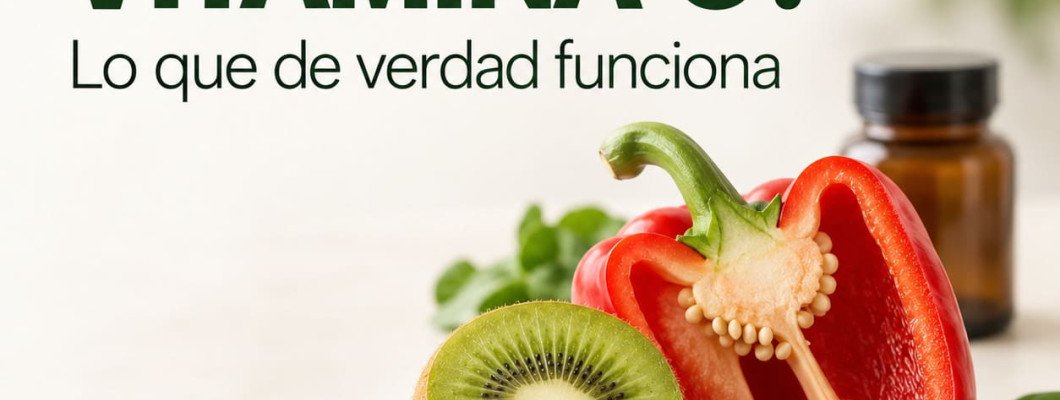
- 30 g of pumpkin seeds give more zinc than an egg and a yoghurt combined, and half a raw red pepper has more vitamin C than a whole orange.
What zinc and vitamin C actually do in the immune system
Both are cofactors. They are not the engine; they are parts without which the engine runs worse. Zinc is involved in hundreds of enzymes and is needed for T lymphocytes to mature; when it is short, the immune response becomes slow and clumsy. Vitamin C accumulates in neutrophils at concentrations far above those in plasma and is used up during infection, which is where the popular idea that it "gets spent" when you are ill comes from.
That explains why correcting a deficiency does change things and why adding more to someone who already meets their needs changes almost nothing. It is the difference between filling the tank and pouring petrol on the ground.
The European Union only allows you to say about a nutrient what it has assessed. For these two, Regulation (EU) 432/2012 authorises, in this exact wording: "Zinc contributes to the normal function of the immune system", "Zinc contributes to the protection of cells from oxidative stress" and "Vitamin C contributes to the normal function of the immune system". There is a fourth with a dose of its own: "Vitamin C contributes to maintain the normal function of the immune system during and after intense physical exercise", which may only be used if the product provides 200 mg a day of vitamin C in addition to the recommended daily intake. And a fifth that almost nobody uses: "Vitamin C increases iron absorption".
Notice what none of the five says. Not "prevents colds", not "strengthens", not "boosts your defences". They say "contributes to the normal function". When a tub promises more than that, it is promising on its own account. In the shop's vitamins and minerals section you can check it label by label: the well-made ones repeat the regulation's wording word for word.
To use those phrases, the product must be at least a "source of" the nutrient, meaning it provides 15% of the reference value. Since the reference value is 10 mg for zinc and 80 mg for vitamin C, that means 1.5 mg and 12 mg. The bar is low, which is why both a capsule and a handful of seeds clear it.
What the trials say, with numbers
The reference review on zinc is Cochrane 2024 (Nault, Wieland et al.): 34 randomised trials and 8,526 participants, 15 on prevention and 19 on treatment, in adults and children. For preventing colds, the risk ratio was 0.93 (95% CI 0.85-1.01) across 9 studies and 1,449 participants, on low-certainty evidence: there may be little or no reduction. For shortening a cold already underway, duration fell by 2.37 days (95% CI −4.21 to −0.53) across 8 studies and 972 participants, again low certainty. Symptom severity did not change appreciably. And there is a toll: non-serious adverse events probably increase — bad taste, nausea, digestive upset — RR 1.34 (CI 1.15-1.55) across 16 studies and 2,084 participants, this time on moderate-certainty evidence. In other words: the least solid figure is the benefit and the most solid one is the nuisance.
The reference review on vitamin C is Cochrane 2013 (Hemilä and Chalker), with doses of at least 0.2 g a day. On incidence: 29 comparisons and 11,306 participants, risk ratio 0.97 (0.94-1.00). Translated: no prevention in the general population. There is one striking exception: in 5 trials with 598 marathon runners, skiers and soldiers under extreme physical stress or intense cold, risk was halved, RR 0.48 (0.35-0.64). On duration: 31 comparisons and 9,745 cold episodes, with 7.7% less in adults (3.7-12%) and 14.2% less in children (7.3-21%), rising to 18% in children on 1-2 g a day. And on therapeutic use — starting it once you already have a cold — 7 comparisons and 3,249 episodes: no consistent effect.
| Question | Zinc | Vitamin C |
|---|---|---|
| Does it stop you catching a cold? | No (RR 0.93; CI 0.85-1.01) | No (RR 0.97; CI 0.94-1.00) |
| Does it shorten a cold? | Yes: −2.37 days, low certainty | Yes, if taken daily beforehand: −7.7% adults |
| What if I start once I'm ill? | That is exactly how it was measured | No consistent effect |
| Does anyone benefit from prevention? | People with a real deficiency | Extreme physical stress: RR 0.48 |
| Measured adverse effects | RR 1.34 of non-serious events | Digestive upset at high doses |
| Upper limit in the EU | 25 mg/day | None established |
| Average intake in Spain | 8.1 mg/day (83% below) | 84.4 mg/day (36% below) |
Six decisions before you buy anything
1. Look first at where your zinc comes from
The ANIBES study, with 2,009 participants aged 9 to 75, puts average Spanish zinc intake at 8.1 mg a day, with meat and meat products supplying 28.5% of it. If you eat little meat, the zinc has to come from somewhere else: seeds — bulk pumpkin seeds are the densest reference in the pantry — pulses such as pardina lentils or pedrosillano chickpeas, and nuts, especially raw cashews. You do not need to do the arithmetic every day: it is enough for two of those three groups to show up daily.
2. You already have the vitamin C
Here the picture is fairly good: 84.4 mg a day on average, with vegetables supplying 50.6% and fruit 20%. Half a raw red pepper is around 95 mg and a kiwi 64. A single pepper in the salad already covers an adult's reference. Frozen fruit and frozen vegetables — frozen right after harvest, and good at keeping vitamin C — are the two cheapest ways of not depending on the season.
3. If you buy zinc, look at the form and the dose, not the brand
Chelated forms and citrate are better tolerated than oxide, which is the cheapest and the worst absorbed. In vitamins and minerals you will find Aldous zinc bisglycinate, Solaray zinc citrate with pumpkin seeds — literally the capsule version of what point 1 suggests — and combined formulas such as biotin with zinc, selenium and vitamins D3 and E. Dose matters more than form: going above 25 mg of total zinc a day adds nothing and competes with copper absorption.
4. If you buy vitamin C, 1,000 mg is not better than 200
Above a certain dose absorption falls and the surplus goes out in urine. The trials that find anything use from 0.2 g a day upwards. Kal's 1,000 mg vitamin C, El Granero's 830 mg vitamin C, Solaray's vitamin C and D combination and Be Levels liposomal vitamin C are all far above the trial threshold. If you pick one, pick it for what comes with it — vitamin D in winter makes more sense than another gram of C — and not for the big number on the label.
5. When supplementing does make sense
Three clear situations. One, a strict vegetarian or vegan diet heavy in wholegrains and pulses: phytates slow zinc absorption and the European reference rises from 7.5 to 12.7 mg a day in women and from 9.4 to 16.3 mg in men depending on the phytate load. Two, very high and prolonged physical effort, the only scenario where vitamin C genuinely prevents colds; there it is worth also looking at proteins and amino acids. Three, repetitive, low-variety diets, where a simple formula such as B complex with vitamin C fills several gaps at once. For everything else, the immune system section is a place to browse slowly, not to empty.
6. What not to do
No zinc nasal sprays: in June 2009 the FDA warned against three such products over cases of loss of smell. No months of chained zinc megadoses, because the European 25 mg a day limit was set precisely because of its effect on copper status. And do not mistake the plants and extracts section for a medicine cabinet: echinacea and propolis have a tradition of use, but no authorised health claim in the EU, and that has to be said.
How much zinc and vitamin C is in what you already eat
Per-serving figures from the US NIH Office of Dietary Supplements database. They are for getting the order of magnitude right, not for counting milligrams to one decimal place.
| Food | Serving | Zinc | Vitamin C | Where to find it |
|---|---|---|---|---|
| Raw oysters | 85 g | 32 mg | — | Not in our range |
| Roasted pumpkin seeds | 30 g | 2.2 mg | — | Seeds |
| Cooked oats | 1 cup | 2.3 mg | — | Cereals and muesli |
| Cheddar cheese | 40 g | 1.5 mg | — | Cheeses |
| Cooked lentils | 1/2 cup | 1.3 mg | — | Pulses |
| Greek yoghurt | 170 g | 1.0 mg | — | Refrigerated |
| Egg | 1 large | 0.6 mg | — | Eggs |
| Raw red pepper | 1/2 cup | — | 95 mg | Vegetables |
| Kiwi | 1 medium | — | 64 mg | Frozen fruit |
| Cooked broccoli | 1/2 cup | — | 51 mg | Frozen vegetables |
| Strawberries | 1/2 cup | — | 49 mg | Frozen |
| Orange | 1 medium | — | 70 mg | Organic baskets |
| Tinned sardine or mackerel | 1 tin | ~1 mg | — | Tinned fish |
Three myths worth dropping
"If I take zinc all winter I don't get colds"
This is the promise that sells the most tubs and stands up worst to the data. In prevention, zinc's confidence interval includes 1: the effect may be nil. What has been measured is the shortening once you already have a cold, and even that on low-certainty evidence. Buying zinc in October so as not to go down in January is buying a benefit nobody has demonstrated.
"Vitamin C cuts a cold short"
If you start it once you have symptoms, no. Seven comparisons and 3,249 episodes found no consistent effect. The 7.7% reduction in duration belongs to people who were already taking it every day before falling ill, and 7.7% of a seven-day cold is about twelve hours. That is fine, but it is not what the pharmacy aisle promises. Superfoods and probiotic capsules do not fix it either: those are different conversations.
"More is better"
Here two official sources disagree, and it is worth knowing. The European Scientific Committee on Food set the upper limit for zinc in 2003 at 25 mg a day for adults, from a no-observed-adverse-effect level of 50 mg and an uncertainty factor of 2, using copper status as the criterion. The US NIH puts it at 40 mg. For vitamin C, EFSA concluded in 2004 that there were not enough data to set a limit, while noting that supplemental doses of up to 1 g a day were not associated with adverse gastrointestinal effects. In Europe the European figure applies: 25 mg of zinc a day from all sources combined.
The shopping list
If you take one idea away, make it this: the September basket matters more than the tub. What you need is in the pantry and in the chilled section, not in a package with a promise.
For zinc: seeds (pumpkin, sesame, bulk hemp), pulses, nuts, oat flakes and muesli, cheeses, eggs and tinned fish. For vitamin C: vegetables — peppers, broccoli, brassicas — plus frozen fruit and frozen for the days with no time. And if you would rather not decide every week, the organic baskets decide for you with whatever is in season. A hot herbal tea cures nothing, but it helps you drink more, which in a cold is half the battle.
Do you need supplements?
For most people reading this, no. If you eat pulses three times a week, seeds almost daily and fruit and vegetables at every meal, you reach the reference for both nutrients without buying anything. We say that knowing we sell the tubs: they are in vitamins and minerals and in immune system, and they will stay there.
That said, there are two cases where a supplement is the sensible, cheap answer. A strict vegan diet heavy in wholegrains, where the phytate load raises zinc needs by nearly 70%. And a spell of very hard training, the only scenario where vitamin C has been shown to prevent colds. Outside that, the money goes further in the vegetable aisle than on the capsule shelf.
Where to buy zinc and vitamin C in Barcelona and Sant Cugat
We have three shops, and in all three you can do something a website cannot offer: compare labels with someone standing next to you. Bring the two tubs you are hesitating between, look at how many milligrams of elemental zinc each one has, see whether they go over 25 mg, and decide on that. And weigh out exactly 30 g of bulk pumpkin seeds to see what a real serving looks like — almost always smaller than people imagine.
- Provença 242, 08008 Barcelona — Eixample district, between Balmes and Enric Granados.
- Còrsega 78, 08029 Barcelona — Eixample, a short walk from Sants station.
- Antoni Bell 2, 08174 Sant Cugat del Vallès — Volpelleres neighbourhood, next to the FGC station.
If you would rather ask before coming, the phone number is +34 683 118 961 and the email is linverd@linverd.com. And if you want it delivered, the whole pantry and the week's offers are in the online shop.
Frequently asked questions
Zinc or vitamin C for immunity?
It depends which one you are short of. In Spain average vitamin C intake already covers the reference for two people in three, while 83% fall short on zinc. If you have to bet on one, zinc is more likely to be low. But neither prevents colds in someone who eats a varied diet.
Does zinc cut a cold short?
It shortens it, it does not cut it short. The 2024 Cochrane review measured a 2.37-day reduction when zinc was started with the cold already underway, on low-certainty evidence and with a probable increase in mild adverse effects. Symptom severity did not change.
How much zinc a day is safe?
The European upper limit for adults is 25 mg a day from all sources, set on copper status. The US NIH works with 40 mg. Exceeding it consistently can interfere with copper absorption, so add up what the supplement provides and what the food provides.
How much vitamin C do I really need?
The usual references are around 75-90 mg a day for an adult, with 35 mg more if you smoke. The European claim about intense exercise requires an extra 200 mg a day, which is a very specific situation. Half a raw red pepper and a kiwi already pass 150 mg.
Is liposomal vitamin C worth it?
The liposomal form aims to improve absorption, but the claims authorised in the EU do not distinguish between forms: the same sentence applies to an ordinary tablet and to a liposomal capsule. There are no clinical trials showing a better outcome against colds, so the decision is about tolerance and price, not demonstrated efficacy.
Can I take zinc and vitamin C together?
Yes, they do not compete with each other. What does compete with zinc is copper, and to a lesser extent iron at high doses. If you take a multinutrient, check that the total zinc does not exceed 25 mg a day. If you have a medical condition or take medication, ask your doctor or pharmacist first.
Where can I buy organic zinc and vitamin C in Barcelona or Sant Cugat?
In our three shops: Provença 242 and Còrsega 78 in Barcelona, and Antoni Bell 2 in Sant Cugat del Vallès. We stock zinc as bisglycinate and citrate, vitamin C in several doses and, above all, the part of the problem that food solves: bulk pulses and seeds, seasonal fruit and vegetables.
Before you close this page
If you arrived looking for which tub to buy and you leave with a bag of pumpkin seeds and a red pepper, the article has done its job. And if you still want the tub, at least now you know what to look for on the label. You can carry on through the health blog, or through three articles that tell the same story about other nutrients: which magnesium to take and why, how much fibre per day you need and melatonin for sleep: how much and what time.
This article is for information only and does not replace advice from a healthcare professional. If you are pregnant, breastfeeding, taking medication or have a medical condition, seek advice before starting any supplement. Food supplements should not be used as a substitute for a varied and balanced diet or a healthy lifestyle.