


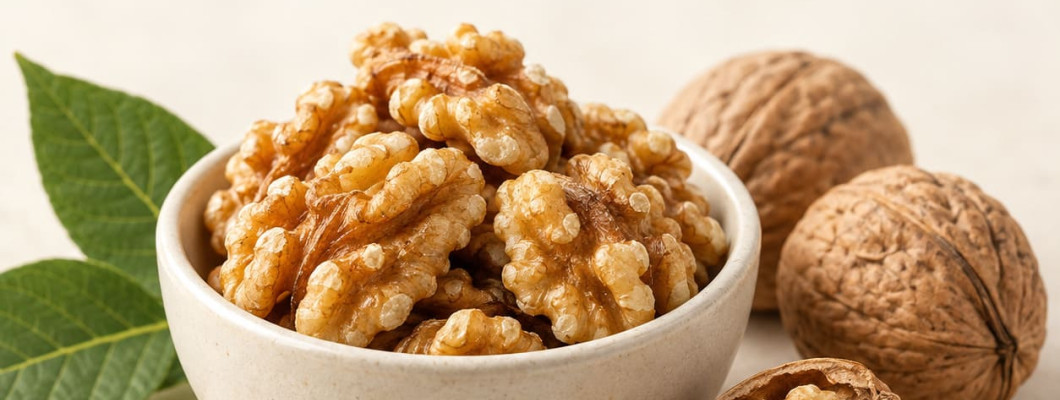
September is when the walnut harvest starts here in Catalonia, and the same question comes back across the counter: how many should you eat a day. The answer has something rare in nutrition going for it — there is an official number. In 2012 the European Union authorised a health claim for walnuts, and that claim comes with an exact dose: 30 grams a day. This is not a magazine rounding: it is what the European Commission allows you to say, and under what conditions.
Now the uncomfortable part. The same body of evidence also says that above a certain amount there is no further benefit, that the largest trial on walnuts and memory came out negative, and that a handful of walnuts does not replace oily fish however much plant omega 3 it carries. Here are both sides.
In short
- The portion is 30 g a day. That is the exact condition of the EU's authorised claim for walnuts: about six or seven shelled walnuts.
- 28 g of walnuts provide 2.57 g of alpha-linolenic acid (ALA), according to the US National Institutes of Health. That clears the 2 g/day threshold the European ALA-and-cholesterol claim requires.
- More is not better. The reference meta-analysis found the curve flattens between 15 and 20 g a day: above that, no further risk reduction was measured.
- Walnuts do not improve memory in healthy older people. The WAHA trial, 708 participants over two years, found no effect on global cognition.
- The calories on the label are overstated. Measured in the lab, 28 g of walnuts deliver 146 kcal instead of the 185 the standard calculation predicts.
- AESAN recommends three or more portions a week, up to one a day, and always with no added salt, fat or sugar. Salted roasted and candied versions do not count the same.
What a handful of walnuts actually does
By composition, the walnut is an outlier among nuts and dried fruit. Almost all the others are essentially monounsaturated fat; the walnut is the only one in everyday use with a meaningful amount of polyunsaturated plant omega 3, alpha-linolenic acid. The US National Institutes of Health (NIH) fact sheet gives 2.57 g of ALA per 28 g of walnuts. Seeds such as flax and chia are more concentrated, but nobody eats 28 g of chia mid-morning without thinking about it.
That amount matters because the European Union allows you to say that "ALA contributes to the maintenance of normal blood cholesterol levels", provided the consumer is told the effect is obtained with a daily intake of 2 g. Thirty grams of walnuts clear that bar unaided.
The walnut's own claim is more specific still. Regulation (EU) 432/2012 authorises this sentence, word for word: "Walnuts contribute to the improvement of the elasticity of blood vessels." And it sets the condition: it may be used only for food providing a daily intake of 30 g of walnuts, with the consumer informed that the beneficial effect is obtained with that amount. It is the only entry in the annex that names a specific nut. Almonds, hazelnuts and pistachios have no equivalent.
On blood lipids, the meta-analysis published in Nutrients in 2022 pooled 13 randomised controlled trials and 1,037 participants, at doses from 15 to 99 g a day. Results: total cholesterol −8.58 mg/dL, LDL −5.68 mg/dL, triglycerides −10.94 mg/dL. HDL did not move. Modest, consistent changes — not a transformation.
For hard outcomes there is PREDIMED, the Spanish trial. It allocated 7,447 people aged 55 to 80 at high cardiovascular risk to three diets; one group added 30 g of mixed nuts a day (15 g walnuts, 7.5 g hazelnuts, 7.5 g almonds). After a median 4.8 years, that group had a hazard ratio of 0.72 (95% CI: 0.54-0.95) versus control. The full caveat belongs here: the original 2013 paper was retracted over randomisation problems at some sites, and republished in 2018 with the corrected analysis. The findings held.
How to reach 30 g without turning it into a chore
1. Pick the moment and stop moving it
The portion you remember is the one with a fixed time. Mid-morning with a coffee or a herbal tea, or mid-afternoon. If you have breakfast at home, the simplest route is onto the yoghurt or the oats and muesli; if you eat out, carry them pre-weighed. The fixed routine is what makes 30 g a day sustainable; everything else is good intentions.
2. Weigh them once and memorise the bulk
Thirty grams of shelled walnuts is about six or seven nuts, or roughly fourteen halves. With in-shell walnuts you need well over twice the gross weight, because more than half of it is shell. Use a scale the first time; after that the eye is not far off. This is where buying loose wins: you weigh the exact portion before you buy, not after.
3. Use them as a cooking fat, not only as a snack
Chopped walnuts do a lot of work on roast vegetables, on a pulse salad or stirred into rice, with a good olive oil and a few spices. Our za'atar and sumac article explains how to build blends that work.
4. Pair them with fibre, which is where almost everyone falls short
The handful of walnuts sits particularly well on top of something that already brings fibre: real wholemeal bread, pulses, fresh fruit. If that sounds like unfinished business, our article on how much fibre you need a day has the numbers and the route to 25 g.
5. Do not replace oily fish
This is the one that costs. Walnut ALA converts to EPA and DHA in the liver, but the conversion is very limited: the NIH report rates below 15% and conclude that taking EPA and DHA directly is the only practical way to raise their levels. Translation: walnuts do not save you the tin of sardines or the mackerel. Treat canned fish as the complement, not the substitute.
6. Buy small amounts, more often
ALA oxidises with light, heat and time: a rancid walnut tastes of cardboard and has lost exactly what you came for. Buying 200 g loose every two weeks from the pantry aisle is a better deal than the discounted kilo that sits six months in the cupboard.
What each nut brings, and which one has its own claim
| Nut (30 g portion) | Plant omega 3 (ALA) | Authorised EU health claim? | Why choose it |
|---|---|---|---|
| Walnut | High: 2.57 g per 28 g (NIH) | Yes, at 30 g/day | The only nut with its own entry in the annex to 432/2012 |
| Almond | Traces | No | Monounsaturated fat, vitamin E and a texture that holds up in baking |
| Hazelnut | Traces | No | Strongly monounsaturated; in season and grown locally in Catalonia |
| Pistachio | Low | No | More protein than the group average; very filling if you shell as you eat |
| Cashew | Traces | No | Creamy texture: the base for sauces and plant-based cheeses |
| Chestnut | Essentially none | No | Not a fatty nut at all: it is starch. Far less energy per portion |
Where the portion fits across the week
| Moment | How | The mistake that spoils it |
|---|---|---|
| Breakfast | Chopped over yoghurt, kefir or oats | Pairing them with sweetened muesli and losing the point of the change |
| Mid-morning | The weighed portion, in a small bag, with coffee or tea | Taking the big bag to the office: you end up eating three portions |
| Lunch | Chopped over roast vegetables, pulse salad or rice | Adding them at the end without removing any other fat from the dish |
| Afternoon | With a piece of fruit or a slice of mature cheese | Swapping them for fried, salted versions |
| Dinner | Better not: it is the meal where they are least needed | Picking at the jar while you cook, the fast lane to 100 g |
Three things people say about walnuts that the evidence does not support
"They look like a brain, so they must be good for memory." The Walnuts And Healthy Aging (WAHA) trial tested exactly that: 708 people aged 63 to 79, two years, with walnuts supplying around 15% of daily energy. Result on global cognition: no difference between groups (p = 0.491). The authors note signals on functional MRI and in higher-risk subgroups, but those are hypotheses for the next trial, not a result.
"If one handful is good, two are better." The meta-analysis of 20 cohorts published in BMC Medicine in 2016 measured risk per 28 g of nuts a day: coronary heart disease 0.71 (0.63-0.80), cardiovascular disease 0.79, total cancer 0.85, all-cause mortality 0.78 (0.72-0.84). For stroke, 0.93 (0.83-1.05): not significant. And the figure that matters here: the relationship is not linear and no further risk reduction was seen above 15-20 g a day. Buying more does not buy more health.
"Nuts are very fattening." Here the nuance runs the other way, and it is one of the few that works in our favour. The US Department of Agriculture measured the energy actually absorbed in 18 adults eating 42 g a day: 5.22 kcal/g against the 6.61 kcal/g predicted by the standard factors, 21% less. A 28 g portion provides 146 kcal, not 185. It is still a dense food, but the label overstates it.
Do you need supplements if you eat walnuts daily?
For cholesterol and vascular elasticity, no: the European claim itself is built on the food, not on a capsule. Thirty grams of walnuts a day clear the ALA threshold comfortably, and neither fatty acids in capsule form nor superfoods add anything on top for someone already eating nuts.
Where a supplement does have a role is EPA and DHA, which walnuts do not provide. If you eat less than two portions of fish a week, there is a conversation to have. But the right order is: first the tin of sardines or mackerel, then the bottle. We sell both, so we can say it without conflict: the tin is cheaper.
One regulatory note that rarely gets made: AESAN, the Spanish Agency for Food Safety and Nutrition, recommends in its 2022 report "3 or more portions of nuts per week, and up to 1 portion a day", adding that they should be chosen "with no added salt, fat or sugar". That is more cautious than the 30 g a day of the European claim, and lower than the 50 g proposed by the EAT-Lancet commission. The sensible range runs from three portions a week to one a day.
The same applies to ALA: EFSA sets the adequate intake at 0.5% of daily energy, while the NIH give it in grams, 1.6 g for men and 1.1 g for women. Either way, 30 g of walnuts cover the figure with room to spare.
The shopping list
The essentials, in order of usefulness. Peeled walnuts in bulk will do the daily work; in-shell walnuts in bulk keep longer because the shell protects the fat from light; and the local peeled walnuts from Can Galderic are the short-supply-chain option. To vary the portion: raw almonds, raw hazelnuts, raw peeled pistachios, raw cashews and the mixed nuts in bulk, all in the nuts and dried fruit aisle.
To build breakfast around the handful: oats, muesli and bars, yoghurt and other refrigerated products, bakery and seasonal fruit. For lunch: pulses, rice, vegetables, canned goods and oils and vinegars. And for the marine omega 3 side, canned fish.
Other useful aisles: seeds to raise ALA without more nut fat, cheeses for the afternoon, dark chocolate if the walnuts are going into baking, biscuits chosen by the label, spices, eggs, frozen food, drinks, this week's offers and the organic baskets if you would rather the weekly shop arrived solved. Plus the fresh chestnuts from Viladrau, which come in now and are nothing like a fatty nut.
On the supplement side, if the conversation goes there: vitamins and minerals, circulatory system, proteins and amino acids, digestive system, plants and extracts, nervous system and diet and nutrition.
Where to buy walnuts loose in Barcelona and Sant Cugat
Our three shops are in Barcelona and Sant Cugat del Vallès, and all three have a loose nut counter:
- Provença 242, 08008 Barcelona — Eixample district, between Balmes and Enric Granados.
- Còrsega 78, 08029 Barcelona — Eixample, near Sants station.
- Antoni Bell 2, 08174 Sant Cugat del Vallès — Volpelleres neighbourhood.
The argument a website cannot copy is simple: ask us to weigh out exactly 30 g of shelled walnuts and look at them in your hand before you buy anything else. It is the only way the portion stops being an abstract number. And take what you will eat in two weeks, not what is cheapest per kilo: the fat goes rancid, and you can come back next Thursday. If you are torn between shelled and in-shell, ask at the counter: it depends on how fast you will get through them, not on price. Phone +34 683 118 961 or email linverd@linverd.com for orders.
Frequently asked questions
How many walnuts are 30 grams?
Between six and seven shelled walnuts, or about fourteen halves, depending on size. In shell you need well over twice the gross weight, because more than half of what you buy is shell. The reliable move is to weigh it once and keep the picture of the handful.
Are walnuts fattening?
They deliver less energy than the label says: measured in the lab, 28 g give 146 kcal instead of the 185 calculated by the standard method, 21% less. They are still a dense food. One portion a day fits almost any diet; three portions with nothing removed does not.
Do they improve memory?
The largest trial on the question, 708 healthy older adults over two years, found no difference in global cognition. There are signals on MRI and in higher-risk subgroups, but those await confirmation. Eating walnuts for memory is not supported by today's evidence.
If I eat walnuts, is my omega 3 covered?
The plant kind, yes: 30 g clears the 2 g of ALA in the European claim. The marine kind, no. Conversion of ALA into EPA and DHA runs below 15%, so walnuts do not replace oily fish. The sensible approach is to do both rather than choose.
In shell or shelled?
In shell they last longer, because the shell protects the fat from light and oxygen; shelled they are more convenient and get used faster. Buying for a month, take them in shell. Buying for two weeks with the portion ready each morning, take them shelled.
Should you soak or "activate" them?
We know of no clinical trial that has measured whether soaking nuts changes anything in the mineral status of the person eating them. Soaking does reduce phytates somewhat and softens the texture. If you prefer them that way, go ahead; if not, you are not missing anything proven.
Where can I buy walnuts loose in Barcelona or Sant Cugat?
At our three shops: Provença 242 and Còrsega 78 in Barcelona, and Antoni Bell 2 in Sant Cugat del Vallès. All three carry shelled and in-shell walnuts loose, and you can ask for the exact amount. Phone +34 683 118 961.
Where to start today
Weigh 30 g once, pick the time and repeat. You can order from the online shop or drop into any of the three shops and take the portion away already weighed. To carry on from here, our article on fibre closes the other classic gap in the Spanish diet, the one on magnesium explains which form makes sense when, and the one on resetting digestion pairs well with a change of routine. For context on the shops, our Còrsega 78 store article; for seasonal produce, the kiwiberry one. And if you sleep badly, the melatonin article and the chronic stress one.
This article is informational and does not replace advice from a healthcare professional. If you have a tree nut allergy, take anticoagulants, follow a prescribed diet or have any medical condition, talk to your doctor or a registered dietitian before changing your diet.