


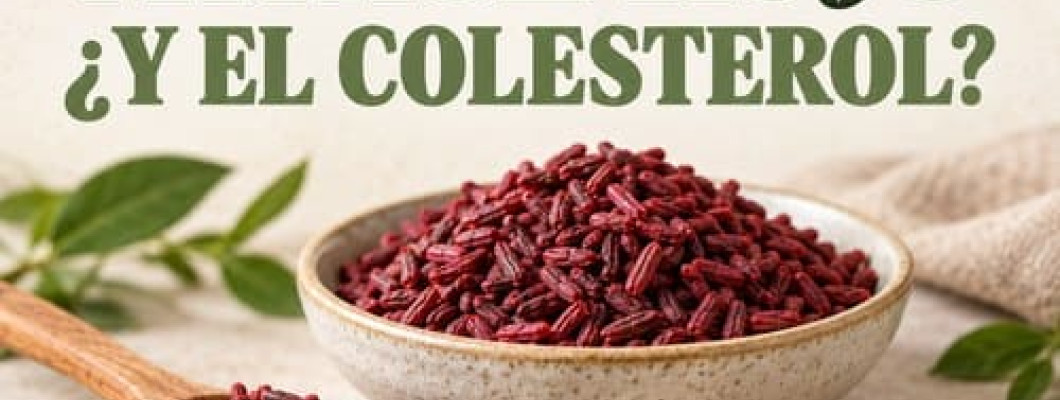
If you have ever looked at the cholesterol shelf in a health shop, you will have seen red yeast rice bottles labelled “2.9 mg of monacolin K”. That odd figure is not a manufacturer's decision: it is the ceiling the law allows. And the law has gone further. In July 2024 the European Commission withdrew the health claim that allowed anyone to say monacolin K helps maintain normal cholesterol, and in March 2026 it notified a draft regulation to ban monacolins in food and supplements altogether.
Here is what happened, with the figures and the regulations in hand, and what is left once the fashionable cholesterol ingredient loses its legal cover. We stock four red yeast rice products in our shops, so this article argues against part of what we sell. We are writing it anyway, because the alternative is that you read it on the label after you have paid for it.
In short
- Monacolin K is, molecule for molecule, lovastatin: a statin prescribed from 10-20 mg a day with monitoring.
- The EU claim that allowed you to say so was granted for 10 mg a day and was withdrawn on 29 July 2024 (Regulation (EU) 2024/2041).
- Since 2022 supplements may not reach 3 mg of monacolins a day. That is where the 2.9 mg on labels comes from.
- The dose that worked in the trials was around 10.4 mg a day: more than three times what you can legally buy.
- On 4 March 2026 the Commission notified the WTO of a draft moving monacolins to the prohibited substances list. As of today it has not been published.
- What does keep an authorised claim: beta-glucans (3 g/day), plant sterols (0.8 g/day) and ten more, almost all of them food.
What red yeast rice is, and why its active ingredient is a medicine
Red yeast rice is neither a yeast nor a red rice variety: it is ordinary white rice fermented with the fungus Monascus purpureus, which dyes it deep red and produces, among other compounds, a group of molecules called monacolins. It has been used as a colouring and a seasoning in China for centuries, and that is what gives it the harmless air it has on the shelf.
The problem is not the rice: it is the monacolins
Monacolin K in its lactone form is identical to lovastatin, the active ingredient of a prescription medicine. And this is not an analogy: the European Commission itself justified withdrawing the claim by pointing to the summary of product characteristics of lovastatin medicines, which carries warnings about the risk of myopathy and rhabdomyolysis and advises against use in pregnancy and breastfeeding.
To see the gap: the summary of product characteristics for generic lovastatin authorised in Spain by AEMPS — the Spanish medicines agency, equivalent to the MHRA or the FDA — gives a range of 10 to 80 mg a day, starting at 20 mg with the evening meal, adjusted every four weeks, and capped at 20 or 40 mg a day if the patient takes ciclosporin, gemfibrozil, other fibrates, niacin at 1 g or more, amiodarone or verapamil. All of that on prescription and with blood tests. The supplement delivers under 3 mg of the same molecule, with no prescription and no blood tests, next to the muesli.
How it works, and why it genuinely works
The mechanism is neither mysterious nor gentle: monacolin K inhibits HMG-CoA reductase, the enzyme the liver uses to make cholesterol. That is exactly the statin mechanism. It is why LDL falls, and it is why it shares the same adverse effects: muscle and liver.
The most cited meta-analysis, by Gerards and colleagues, pooled 20 randomised trials and 6,663 participants and found an LDL cholesterol reduction of 1.02 mmol/l (95% CI −1.20 to −0.83), roughly 39 mg/dl. That is a large drop, comparable to a low-dose statin. But the authors themselves warn that the quality of safety assessment was low in most of the studies, and that the extract could only be considered safe if that profile is confirmed in trials that measure adverse effects properly. The paper's title sums it up better than we can: significant LDL reduction, safety uncertain.
A second meta-analysis, by Li and colleagues, kept only the 15 methodologically strongest trials and 1,012 participants: LDL −28.41 mg/dl (95% CI −37.01 to −19.81), with 88% heterogeneity. Against statins there was no difference in LDL, but red yeast rice lowered total cholesterol less. In other words: it works like a weak statin, which is what it is.
The number that matters: the trials used 10 mg and you can buy 2.9
This is where the whole thing knots together, and it is arithmetic, not opinion. The mean monacolin K dose in the Gerards meta-analysis was 10.4 ± 4.5 mg a day. The EU claim, while it existed, required telling the consumer that the effect was obtained with 10 mg a day of monacolin K. And since June 2022 it has been illegal to sell food delivering 3 mg or more of monacolins in the recommended daily portion.
Those three figures do not fit together. The dose with evidence behind it is more than three times the legal dose. That is literally the reason the Commission gave for withdrawing the claim: since a product delivering the 10 mg the claim required can no longer be sold, keeping it on the list made no sense and created legal uncertainty.
Put differently: the bottle of 2.9 mg of monacolin K on the shelf is designed to sit one tenth below the ceiling, not to reach a studied dose. Nobody has shown what 2.9 mg a day does to your cholesterol. And the very opinion that led to the 3 mg ceiling describes serious adverse reactions at intakes of as little as 3 mg a day.
What changed in the law, in order
This is the full timeline, all of it checkable on EUR-Lex. It is the best summary we can give of why the same product went from holding a European health claim to being one step away from a ban.
| Date | Rule or opinion | What it established |
|---|---|---|
| 28/07/2011 | EFSA opinion, the European Food Safety Authority (EFSA Journal 2011;9(7):2304) | Cause and effect between monacolin K and maintenance of normal LDL cholesterol, at 10 mg/day |
| 16/05/2012 | Regulation (EU) 432/2012 | Authorises the claim “Monacolin K from red yeast rice contributes to the maintenance of normal blood cholesterol levels”, conditional on 10 mg a day |
| 07/11/2019 | Regulation (EU) 2019/1901 | Lowers the maximum citrinin content in these supplements to 100 µg/kg (entry 2.8.1 of the Annex to Regulation 1881/2006) |
| 25/06/2018 | EFSA opinion (EFSA Journal 2018;16(8):5368) | At 10 mg/day there is a significant safety concern; serious cases at just 3 mg/day; no safe intake can be established |
| 01/06/2022 | Regulation (EU) 2022/860 | Puts monacolins in Part C of Annex III to Regulation 1925/2006 (under Union scrutiny), bans 3 mg/day or more and requires a label warning |
| 29/07/2024 | Regulation (EU) 2024/2041 | Withdraws the monacolin K health claim from the EU list |
| February 2025 | EFSA opinion (EFSA Journal 2025;23(2):9276) | With the additional data submitted by industry, a safe daily intake still cannot be established |
| 04/03/2026 | Draft regulation notified to the WTO | Proposes moving monacolins to Part A of Annex III, the prohibited substances list, with 12 months to sell through existing stock |
One detail is worth underlining, because it is rare: an authorised health claim is almost never withdrawn. The normal course is for an application to be rejected before it ever reaches the list. Here the claim stood for twelve years and fell through the back door, not because anyone stopped believing in the effect, but because the dose needed to obtain it became illegal.
And one fact we checked today, 26 October 2026: the draft ban has still not been published. The consolidated version of Regulation 1925/2006 on EUR-Lex is still the one of 26 November 2025, so monacolins remain in Part C, with the 3 mg ceiling and the mandatory warning. When it is published, there will be twelve months to sell what is already on the market.
Five steps if you have just been told your cholesterol is high
This is no minor matter in Spain, where our three shops are. The ENRICA study measured 11,554 adults and found hypercholesterolaemia in 50.5%. Of those with raised LDL, only 53.6% knew about it; of those, 44.1% were on treatment; and of those treated, 55.7% were at target. Multiply it out: barely 13 in 100 people with high cholesterol have it under control. The problem is not a missing bottle on the market.
1. Ask for the numbers, not the headline
“High cholesterol” is not a data point. LDL, total cholesterol, HDL, triglycerides and above all the overall cardiovascular risk your doctor calculates from age, blood pressure and smoking — those are. An LDL of 140 mg/dl means one thing in a 35-year-old with no other risk factor and something very different in a 60-year-old with hypertension. What decides whether treatment is needed is that whole picture, not one figure on its own.
2. Change the fat before you add anything
Of the twelve cholesterol claims still in force in Europe, five are about exactly this: replacing saturated fats with unsaturated ones. The official wording for oleic acid says that “replacing saturated fats in the diet with unsaturated fats contributes to the maintenance of normal blood cholesterol levels”. It does not say add: it says replace.
In practice that means extra virgin olive oil instead of butter for cooking, and checking the oils and vinegars aisle before the capsule shelf. Our post on how much olive oil per day has the detail on the 20 grams and the polyphenols.
3. Get soluble fibre in every day, not one day
Oat and barley beta-glucans have their own authorised claim and a clear condition: 1 gram per quantified portion, with the effect obtained at 3 grams a day. Using the minimum contents required by US rules (21 CFR 101.81: 5.5% in bran and 4% in flakes), those 3 grams come from roughly 55 g of oat bran or 75 g of flakes.
That is a generous breakfast bowl, every day. We stock oat bran and loose oat flakes in cereals, bars and muesli, and the full arithmetic is in our post on how much oats per day. Pulses and vegetables do the rest of the work; the post on reaching 25 grams of fibre has the complete plan.
4. If you are going to use a supplement, pick the one that keeps its claim
Plant sterols and stanols still hold an authorised claim: “Plant sterols/stanols contribute to the maintenance of normal blood cholesterol levels”, on condition that consumers are told the effect is obtained with a daily intake of at least 0.8 g. And here there is an honest argument for the capsule: 0.8 grams of plant sterols a day is not reachable on a normal diet, which supplies around a quarter of that. It is one of the few cases where the supplement does not replace food, because food does not get there.
On our shelves that is Solgar's Phytosterol Complex, in circulatory system. Check the milligrams per capsule and do the division: if the recommended daily dose does not reach 800 mg of sterols, it does not meet the claim's condition.
5. If you are taking red yeast rice anyway, check these three things
First, the milligrams of monacolin K, not of extract. Second, citrinin: a mycotoxin produced by the same fungus, with known nephrotoxicity, whose limit was cut in 2019 all the way to 100 µg/kg because EFSA could not rule out that the level considered safe for the kidney still carried a genotoxicity risk. Ask whether the manufacturer tests for it batch by batch.
Third, interactions. Monacolins are metabolised by the CYP3A4 enzyme, and the Commission itself flagged concurrent intake with foods or drugs that inhibit it as an uncertainty. If you take azole antifungals, clarithromycin, some antiretrovirals, or if you are already on a statin, this is not one more supplement: it is doubling a statin without telling anyone. And it is not to be taken in pregnancy or while breastfeeding.
The twelve cholesterol claims that are still in force
This is the useful part of the story. The EU list did not empty out when monacolin K fell: twelve authorised claims on blood cholesterol remain, and most of them point at the food aisles, not the capsule shelf. Here they are, with the daily dose each one sets.
| Active | Daily dose set by the regulation | Where it is on our shelves |
|---|---|---|
| Oat or barley beta-glucans | 3 g (and 1 g per quantified portion) | Oat bran and flakes, in cereals and muesli |
| Plant sterols and stanols | 0.8 g minimum | Dedicated supplement, in circulatory system |
| Oleic acid | No dose: requires high unsaturated fat content | Extra virgin olive oil, in oils and vinegars |
| Mono or polyunsaturated fatty acids | No dose: same content requirement | Oils, nuts and seeds |
| Alpha-linolenic acid (ALA) | 2 g | Walnuts, flax and chia, in nuts and seeds |
| Linoleic acid | 10 g (and 1.5 g per 100 g and 100 kcal) | Seeds and seed oils |
| Low or reduced saturated fat | No dose: a content condition of the food | Labelling across the pantry |
| Pectins | 6 g | Fruit, mainly apple and citrus |
| Guar gum | 10 g | Not stocked |
| Konjac glucomannan | 4 g | Supplement, with a choking warning |
| Chitosan | 3 g | Not stocked |
| Hydroxypropyl methylcellulose | 5 g | Not stocked |
Notice the pattern: of the twelve, nine are covered by food and three are technical fibres almost nobody takes. The only one that genuinely calls for a supplement is plant sterols, and for a specific, checkable reason: the dose does not fit in a normal diet.
Omega 3 is not on this list, and it is worth saying why: its authorised claims are about heart function, blood pressure and triglycerides, not cholesterol. If LDL is what worries you, EPA and DHA and the fatty acids aisle are not where to start, even though fish oil and sardines in olive oil make sense for other reasons.
Four things people say about red yeast rice that do not hold up
“It is the natural alternative to statins”
It is not an alternative to statins: it is a statin, in packaging that needs no prescription. Monacolin K in lactone form and lovastatin are the same molecule. What is natural is the origin, not the mechanism and not the adverse effects. Someone who cannot tolerate a statin because of muscle pain has a fair chance of not tolerating this either, and with nobody measuring their creatine kinase.
We are saying this while stocking four products in circulatory system: if your aim is to avoid a statin, this is not the way.
“If it is on the shelf, the EU must think it works”
Exactly the opposite. The EU took the claim away on 29 July 2024, and in March 2026 proposed banning monacolins. A product still being on the shelf means it is still legal below 3 mg, not that it is endorsed. That is a distinction the packaging will not explain to you.
And here is a measurement from our own shelf: of the four products we stock, one still publishes the claim that was withdrawn in 2024 on its product page. We found it while writing this article and we are going to fix it. If it happens to us, it happens elsewhere.
“2.9 mg is the right dose”
2.9 mg is one tenth below the legal limit. It is not the result of a trial: it is the result of a regulation. The studies that demonstrated the LDL drop used an average of 10.4 mg a day, and the withdrawn claim asked for 10. Nobody has measured what 2.9 mg sustained over time does, in efficacy or in safety.
And if someone suggests taking two capsules to reach 5.8 mg, that is precisely what the rules prohibit, and it is also the range where the EFSA opinion describes rhabdomyolysis, hepatitis and skin disorders requiring hospitalisation.
“One bottle sorts it out”
The ENRICA figures say only 13 in 100 people with high cholesterol in Spain have it under control, and that nearly half do not even know they have it. No capsule of any kind solves that: it is solved with a blood test, a risk calculation and, in the kitchen, by changing which fat you cook with and how much soluble fibre goes in each day.
If your doctor has set you an LDL target, food helps you get there and replaces nothing. And if they have put you on a statin, antioxidants and coenzyme Q10 are a conversation to have with them, not a purchase to make online.
The shopping list
If you got this far looking for what to put in the basket, this is what is actually backed up.
For beta-glucans, oat bran and loose thick oat flakes, in cereals, bars and muesli. To change the fat, extra virgin picual olive oil and the rest of the oils and vinegars. For soluble fibre and plant protein, loose pardina lentils and the other pulses, plus fresh vegetables and an organic basket if that suits you better than picking item by item.
For ALA and unsaturated fats, loose walnuts in shell and the rest of the nuts and dried fruit, plus flax and chia in seeds. For oily fish, sardines in extra virgin olive oil and the canned fish aisle, with the dose detail in our omega 3 post.
And in supplements, in order of legal backing: plant sterols first; fatty acids and vitamins and minerals if there is a deficiency to correct; and the plants and extracts aisle, knowing that berberine has no authorised claim in Europe either. New arrivals and current batches are in offers.
Are cholesterol supplements necessary?
For most people, no. Cholesterol responds to three things with solid evidence — the type of fat in the diet, soluble fibre and body weight — and to a fourth you cannot buy, which is exercise. The twelve authorised claims that remain are almost all about foods precisely because that is where the measured effect is.
There are two reasonable exceptions. One is plant sterols, for the arithmetic reason above: 0.8 grams a day does not come out of ordinary food. The other is a documented deficiency of something specific, corrected with whatever is actually missing rather than a multivitamin just in case.
Red yeast rice is not on that list, and not because it does not work. It is out because the dose that works is banned, the permitted dose has not been studied, the active ingredient is a medicine with meaningful interactions, and the product carries a mycotoxin with its own legal limit. Four separate and sufficient reasons, and none of them is “it is useless”.
If what you want is the effect of a statin, the coherent move is to ask your doctor for a statin, with its dose, its blood monitoring and its interaction review. It is cheaper, it is safer and it has been measured.
Where to buy cholesterol supplements and food in Barcelona and Sant Cugat
We have three shops, all of them in Spain, and for this particular subject the physical shop wins because of something a website cannot do: read the bottle with you.
Bring the pack you already have at home, or the one you are about to buy, and we run three checks at the counter: how many milligrams of monacolin K the recommended daily dose delivers — not how many of extract — whether the manufacturer tests citrinin batch by batch, and what medication you take, because lovastatin's interaction list is long and specific. That third question is the one no online shop will ask you, and it is the one that actually matters.
And for the part we do recommend, buying loose lets you try before committing: you can take 55 grams of oat bran, which is the amount covering the day's 3 grams of beta-glucans, and find out whether you will really eat it every morning before carrying home the half-kilo bag. What decides whether a breakfast sticks is not the science, it is whether you like it.
We are at Provença 242, 08008 Barcelona (Eixample, between Passeig de Gràcia and Balmes), at Còrsega 78, 08029 Barcelona (Eixample, near Sants) and at Antoni Bell 2, 08174 Sant Cugat del Vallès (Volpelleres). The phone is +34 683 118 961 and the email is linverd@linverd.com. If you would rather browse at your own pace, the health blog and the online shop are open at any hour.
What we measured on our own shelf
While writing this article we counted and read the four red yeast rice products we stock, all of them in circulatory system, a category that now holds 59 products. The result is uneven and we would rather publish it.
All four state the milligrams of monacolin K, which is correct and does not always happen. Three of four mention pregnancy or breastfeeding. None of the four product pages reproduces the warning that Regulation 2022/860 requires on the physical label, the one about not consuming 3 mg or more a day. None mentions citrinin, and none says that monacolin K is lovastatin. And one still publishes the health claim withdrawn in July 2024.
We are going to fix that. We are telling you because an article criticising an industry's labels without looking at its own is not worth much.
Frequently asked questions
Is red yeast rice banned in Spain?
No, not as of today. What has been banned since June 2022 is selling food and supplements that deliver 3 mg or more of monacolins in the recommended daily portion. Below that figure they remain legal. In March 2026 the Commission notified a draft regulation to ban them outright, and it has not been published yet.
Why do the bottles say 2.9 mg of monacolin K?
Because it is the highest figure possible without reaching the legal limit of 3 mg a day set by Regulation (EU) 2022/860. It does not correspond to any studied dose: the trials that demonstrated the cholesterol drop used an average of 10.4 mg a day, more than three times as much.
Can I take red yeast rice if I am already on a statin?
Not without asking your doctor. Monacolin K is lovastatin, so adding it to another statin means raising the total dose with no monitoring. It should also not be combined with drugs that inhibit the CYP3A4 enzyme, such as some antifungals and antibiotics. And it is not advised in pregnancy or breastfeeding.
What is citrinin and why should I care?
It is a mycotoxin produced by the same fungus that ferments the rice. Its nephrotoxicity is known and EFSA could not rule out a genotoxicity risk at the level considered safe for the kidney. In 2019 the EU lowered its maximum content in these supplements to 100 µg/kg. Ask whether the manufacturer tests it batch by batch.
If I stop taking it, what do I replace it with?
With the two things that keep an authorised claim and a concrete dose: 3 grams a day of oat or barley beta-glucans, which comes from about 55 g of bran or 75 g of flakes, and 0.8 grams a day of plant sterols, which do need a supplement because a normal diet does not get there. And swapping saturated fat for olive oil.
How much does oats really lower cholesterol?
Less than a statin and less than the marketing promises, but it is measured. The European beta-glucan claim is authorised at 3 grams a day, and in the trials the effect on LDL is modest and highly variable between people. It is set out in detail in our article on how much oats per day.
Do you stock red yeast rice?
Yes, four products, and this article explains why we do not recommend it as a first choice. If you decide to take it, come to any of the three shops with the bottle and we will go through it with you: milligrams of monacolin, citrinin testing and interactions with your medication.
Further reading
You can order all of this from the online shop or drop in at Provença 242 and Còrsega 78 in Barcelona, or at Antoni Bell 2 in Sant Cugat del Vallès. If you have a question about a specific label, +34 683 118 961 and linverd@linverd.com are there for that.
If this article helped, these three cover the same problem from another angle: how much oats per day and the 3 g of beta-glucans, how much olive oil per day and what the polyphenols measure and how much fibre per day and how to reach 25 grams. And if it is the good fats you are after, how many walnuts a day and how much dark chocolate a day complete the map.
This article is general information and does not replace advice from a doctor or pharmacist. If you take medication, have been diagnosed with high cholesterol, are pregnant or breastfeeding, ask before taking any food supplement.