


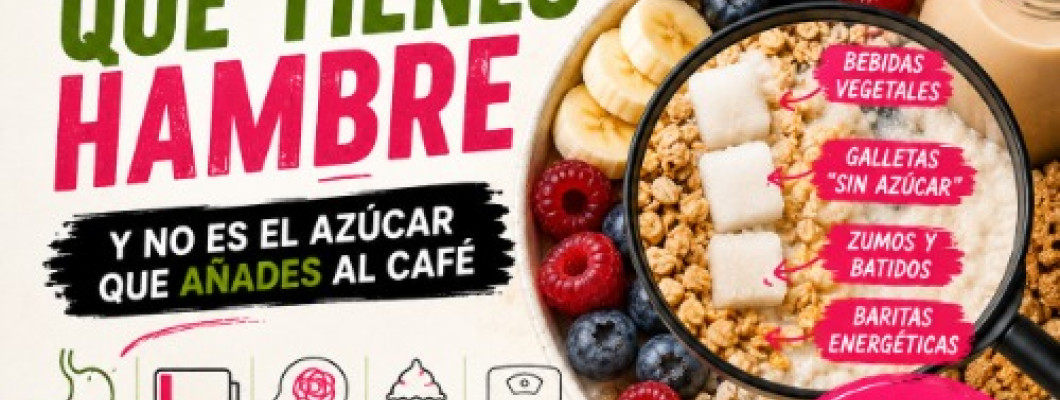
The Sugar That Makes You Think You're Hungry
And it’s not the sugar you add to your coffee
It’s the sugar in your “healthy” breakfast.
Peter is 58 years old. Every morning, he has coffee with wholegrain plant-based drink and some “no added sugar” biscuits. By mid-morning, he is hungry again. After lunch, he needs another coffee. In the afternoon, he looks for something sweet to keep going: an energy bar with blended dates and honey.
At night, he feels tired, low on energy, and has the feeling that staying in shape gets harder every year.
He thought he was just getting older. But the problem was not age. It was the sugar he could not see.
We are not talking about the sugar he added to his coffee. He had that perfectly under control. We are talking about the sugar found in foods that look healthy and that we often consume every day without realizing it.
Why do we like sugar so much?
For most of human history, finding food was not easy. Sweet foods offered a huge evolutionary advantage: they meant quick energy, were rarely toxic, and helped humans survive during times of scarcity.
The problem is that our brain still looks for sugar as if we lived in scarcity, while we are actually surrounded by abundance.
Sugar does not have just one face
One of the biggest mistakes is thinking that all sugar is the same. It is not.
1. Intrinsic sugar
This is the sugar naturally present in food. It is found in fruits, vegetables, whole grains, and legumes. It comes together with fiber, water, vitamins, minerals, and other beneficial compounds.
2. Released sugar
These are sugars that were originally inside the food but become more accessible after processes such as blending, juicing, or crushing. Examples include juices, smoothies, date paste, honey, and some plant-based drinks.
3. Added sugar
This is sugar added during the manufacturing or preparation of foods. It is found in soft drinks, pastries, biscuits, sweetened cereals, and industrial desserts.
The “healthy” breakfast that may make you hungrier
It is not only about how much sugar a food contains. What matters is what comes with that sugar.
We do not eat sugar. We eat foods. And context changes everything.
The food matrix: the concept that changes everything
Fiber, protein, healthy fats, and the physical structure of a food can modify digestion speed, glucose absorption, satiety, and hormonal response.
That is why an apple is much more satisfying than a glass of juice. And that is why a date with pistachio cream has a different impact than an energy bar made with blended dates. Like the dates of Linverd.
The mistake we make when reading labels
Many people look for one single phrase on the package: “no added sugar”. But that is not always enough.
A product may contain no added sugar and still provide significant amounts of sugar.
- Plant-based drinks made from cereals such as rice, oats, or spelt.
- Biscuits made with blended dates or honey.
- Smoothies.
- Products sweetened with fruit concentrates.
The important question is not: “Does it contain sugar?” The truly useful question is: where does that sugar come from?
Five signs you may be consuming more sugar than you think
- You feel hungry shortly after eating.
- You need something sweet every afternoon.
- You often experience energy crashes.
- You find it hard to enjoy foods that are not very sweet.
- Your breakfast depends on biscuits, refined cereals, juices, or plant-based drinks.
Five changes that can transform your energy
- Choose whole fruit instead of juices.
- Add protein to your breakfast.
- Combine fast-absorbing carbohydrates with healthy fats and fiber.
- Always read the ingredient list.
- Gradually replace sugary drinks with sparkling water or herbal infusions.
The problem is not sugar. It is not knowing where it is.
Taking care of your health does not mean living in fear of sugar. It means understanding it better.
When we stop seeing it as an enemy and start understanding it, we recover something much more important: the ability to choose.